

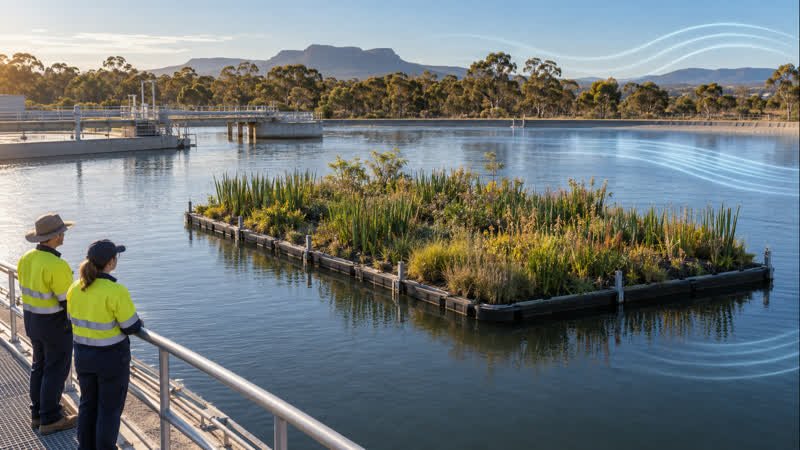
A two-year Australian trial has found that a floating wetland can reduce greenhouse-gas emissions from a wastewater treatment lagoon.
The full-scale study used a 330-square-metre platform planted with native vegetation at a lagoon on Phillip Island in Victoria. Researchers reported carbon-dioxide-equivalent emissions were 22 to 31 per cent lower after the system was installed.
Methane emissions were reported to be 32 to 66 per cent lower, carbon dioxide 24 to 36 per cent lower and nitrous oxide 18 per cent lower. The reductions emerged within four to seven months.
The work involved RMIT University, Westernport Water and CSIRO. Researchers say the approach could offer a lower-cost nature-based option for some treatment facilities.
The results come from one full-scale trial, and further testing will be needed to determine how well the system performs at other sites and under different conditions.
Illustration disclosure: The featured image is an AI-generated editorial illustration, not a photograph of the trial site.